In 1998 a legal settlement forced the tobacco industry to release ~15 million internal documents. Pair them with the ads that actually ran and you get the whole machine: what they decided in private, and what they showed you in public. Thirty pairs, verbatim.
click or press → to begin · 30 slides
“Think of the cigarette pack as a storage container for a day’s supply of nicotine… Think of the cigarette as a dispenser for a dose unit of nicotine.” — Philip Morris researcher William Dunn, Motives and Incentives in Cigarette Smoking, 1972 (UCSF jcl78e00)
Internally they described the cigarette as a drug-delivery device. Publicly, for decades, they denied nicotine was addictive at all.
“Moreover, nicotine is addictive. We are, then, in the business of selling nicotine, an addictive drug effective in the release of stress mechanisms.” — Addison Yeaman, Brown & Williamson general counsel, 1963. Sixteen years later, BAT: “We are searching explicitly for a socially acceptable addictive product… the essential constituent is most likely to be nicotine.” (1979)
Thirty-one years before seven CEOs testified under oath that nicotine was not addictive.

In the 1960s Philip Morris found that ammoniated tobacco releases nicotine in its freebase form — a faster, harder hit from the same cigarette. Marlboro’s market dominance was built on this chemistry. Competitors spent years trying to reverse-engineer “the secret.”
When the freebasing research surfaced, PM pointed to ammonia’s legitimate uses (flavor, puffing tobacco volume) as cover for why it was in the recipe.

Liggett’s “XA Project” (1970s): adding a palladium catalyst destroyed cancer-causing compounds — tumors virtually eliminated in mouse tests. Industry lawyers feared a safer cigarette implied all others were dangerous. Per Liggett’s own outside counsel, rivals pressured them to scuttle it; a company that sold one “could have nothing to do with… the industry’s [legal] position.”
They held a patent for it (US 4216784, filed quietly). The cigarette never shipped.

Philip Morris bought the INBIFO research institute in Cologne, Germany, and routed its animal-toxicity research through a Swedish “coordinator” — a cutout designed so the work couldn’t be traced back to PM or subpoenaed in US court. The unpublished INBIFO findings (sidestream smoke is more toxic than mainstream) contradicted everything the industry said publicly.
Most of what INBIFO published was the safe stuff. The dangerous findings stayed in Cologne.

“It is important to know as much as possible about teenage smoking patterns and attitudes. Today’s teenager is tomorrow’s potential regular customer… We will no longer be able to rely on a rapidly increasing pool of teenagers from which to replace smokers.” — PM researcher Myron Johnston, 1981 (Bates 1000390803)
Internally: “replacement smokers.” Publicly, every exec swore they never marketed to kids.

JAMA, 1991: 97.7% of children recognized Old Joe — kids identified the brand better than adults did (93.6% vs 57.7%). Camel’s share of the illegal children’s market went from 0.5% to 32.8% — roughly $476M/year from kids.
A separate JAMA study found 91.3% of six-year-olds matched Joe Camel to cigarettes — on par with Mickey Mouse. The FTC formally charged the campaign as illegal in 1997.

Brands openly competed for campuses — this 1947 Chesterfield ad brags about being “the largest selling cigarette in America’s colleges,” with the young man “up on our ABC’s.” Sample programs and vending machines put product within reach of minors for decades.

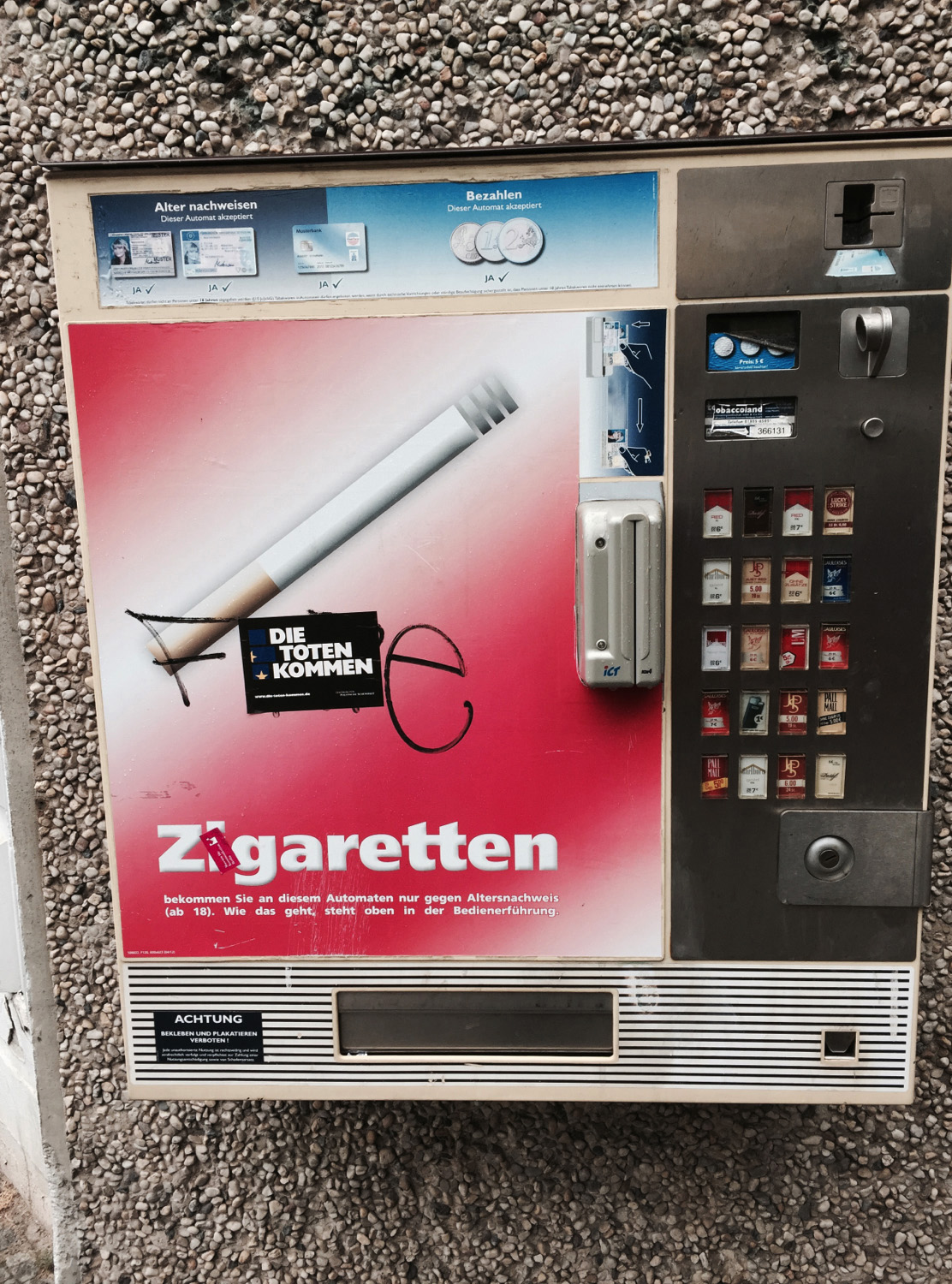
Candy makers sold cigarette-shaped candy in packaging mimicking Camel, Old Gold, Pall Mall, Lucky Strike — the industry let it happen for decades. Kids practiced the ritual and learned the brands before they could read.

Every December the brands ran Santa endorsements — here, Saint Nick himself is “guard[ing] against throat-scratch” by smoking Pall Malls. Christmas, co-opted for nicotine.

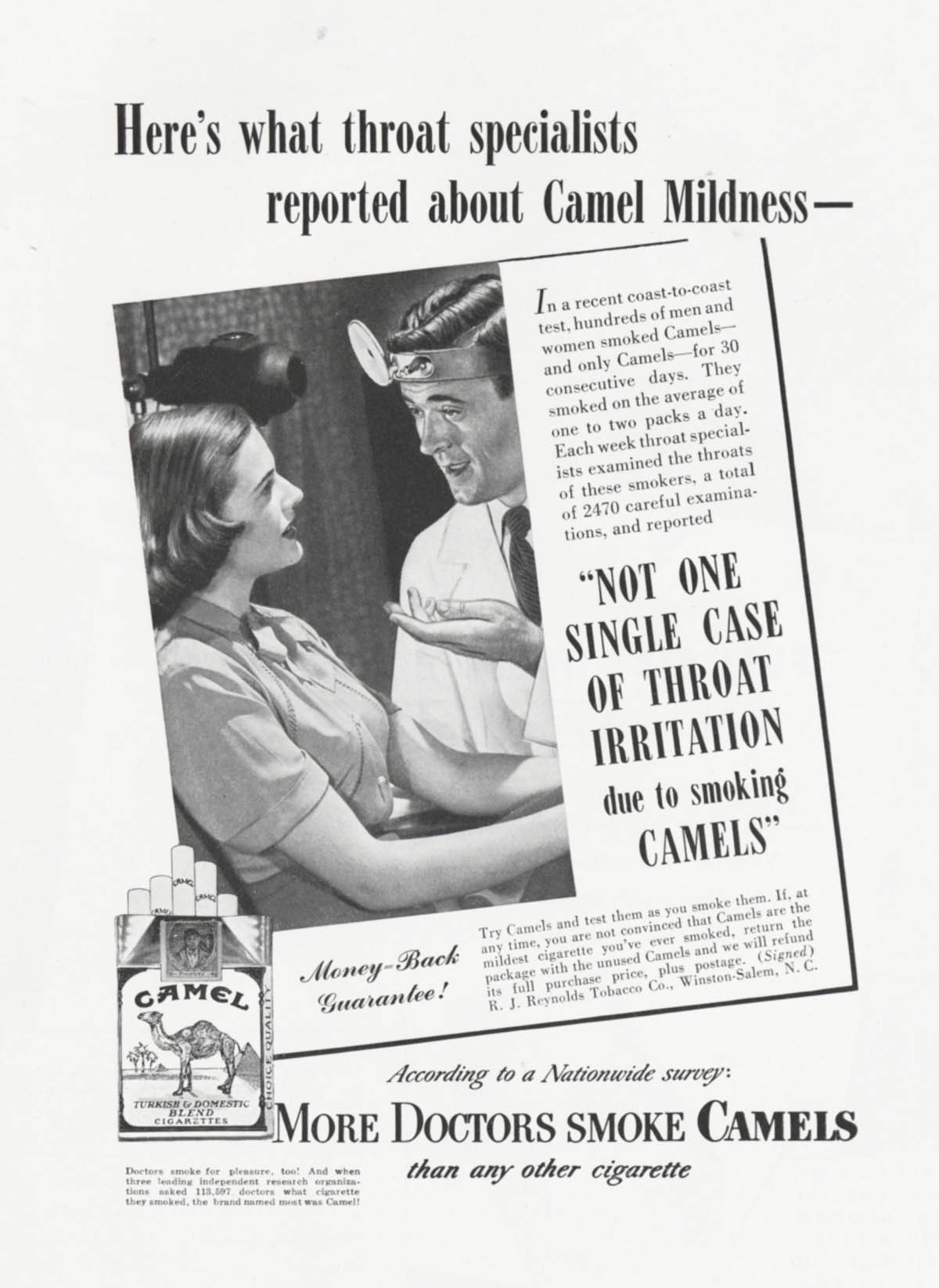
The “nationwide surveys” were run at medical conventions where free cartons were handed out. Lucky Strike’s version: “20,679 physicians say Luckies are less irritating.” JAMA itself ran cigarette ads for roughly two decades.
The profession tasked with warning the public was the ad campaign.

“Hundreds of men and women smoked Camels… Each week throat specialists examined these smokers… and reported NOT ONE SINGLE CASE OF THROAT IRRITATION.” Old Gold’s rival slogan: “Not a cough in a carload.”
They knew smoking caused cancer by the mid-50s. The ads ran anyway.

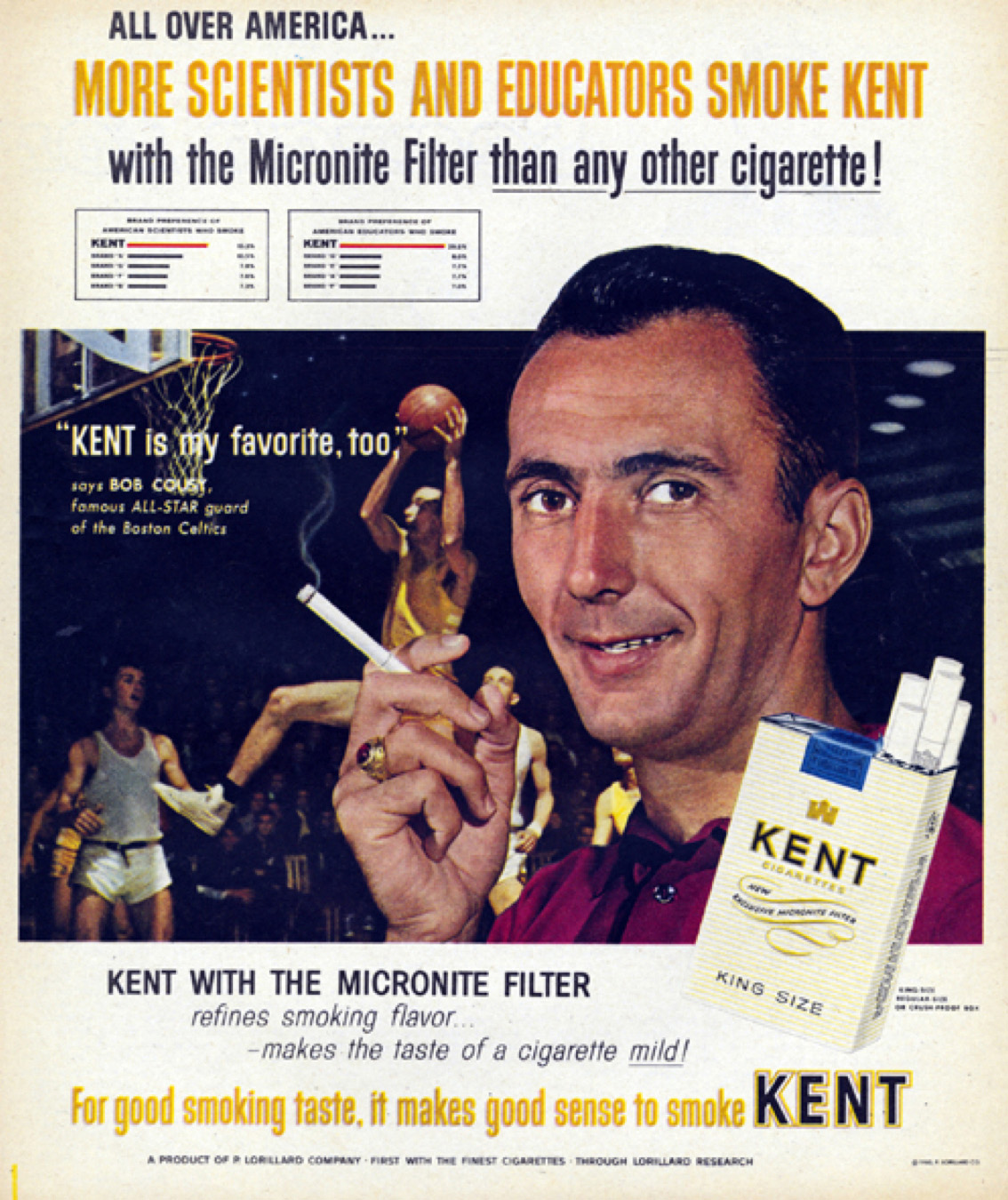
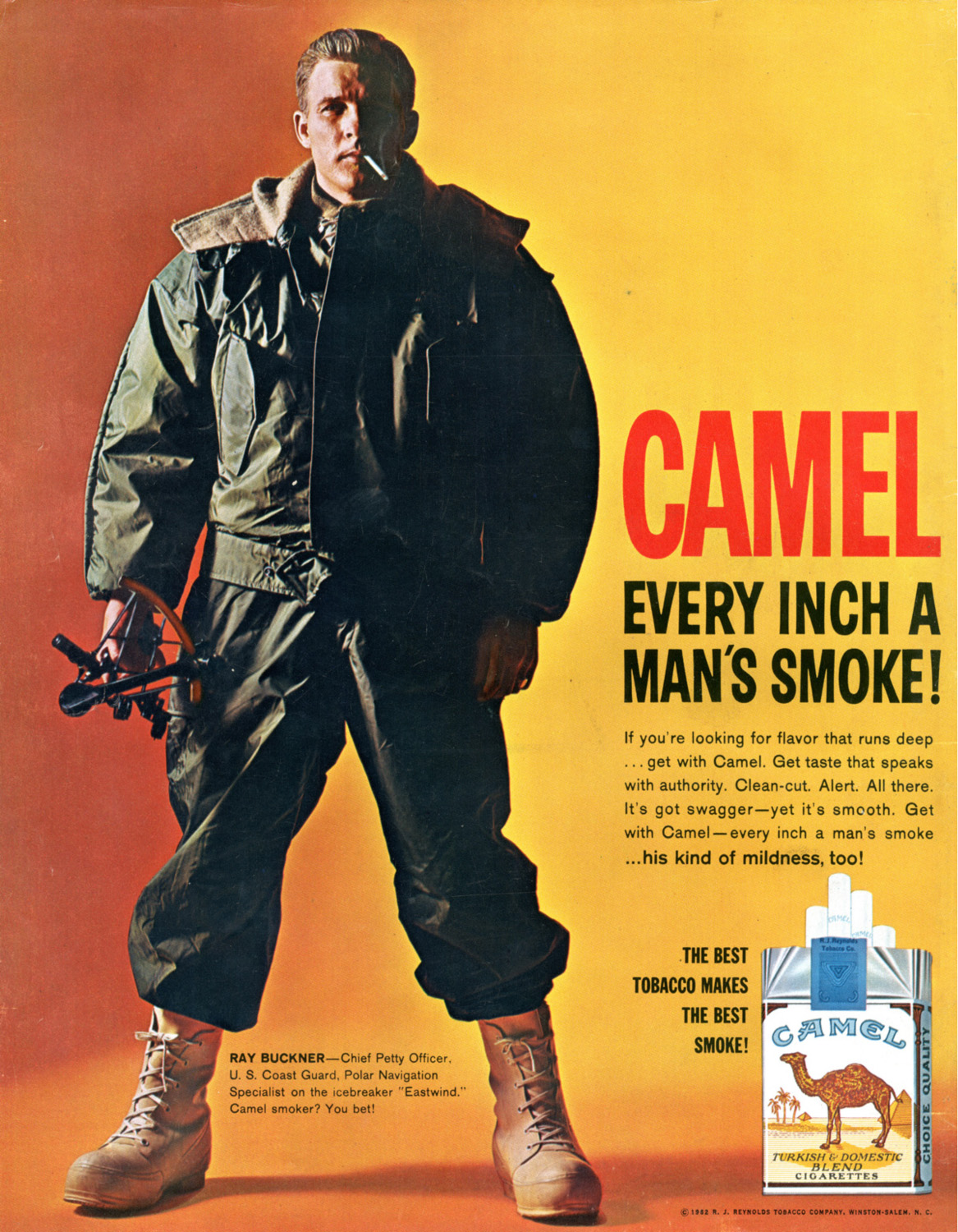
Decades of paid endorsements from film stars, athletes, broadcasters. Philip Morris paid ~$42,500 to put Marlboro trucks into Superman II (a kids’ movie) and ~$350,000 for Lark placement in James Bond’s Licence to Kill.

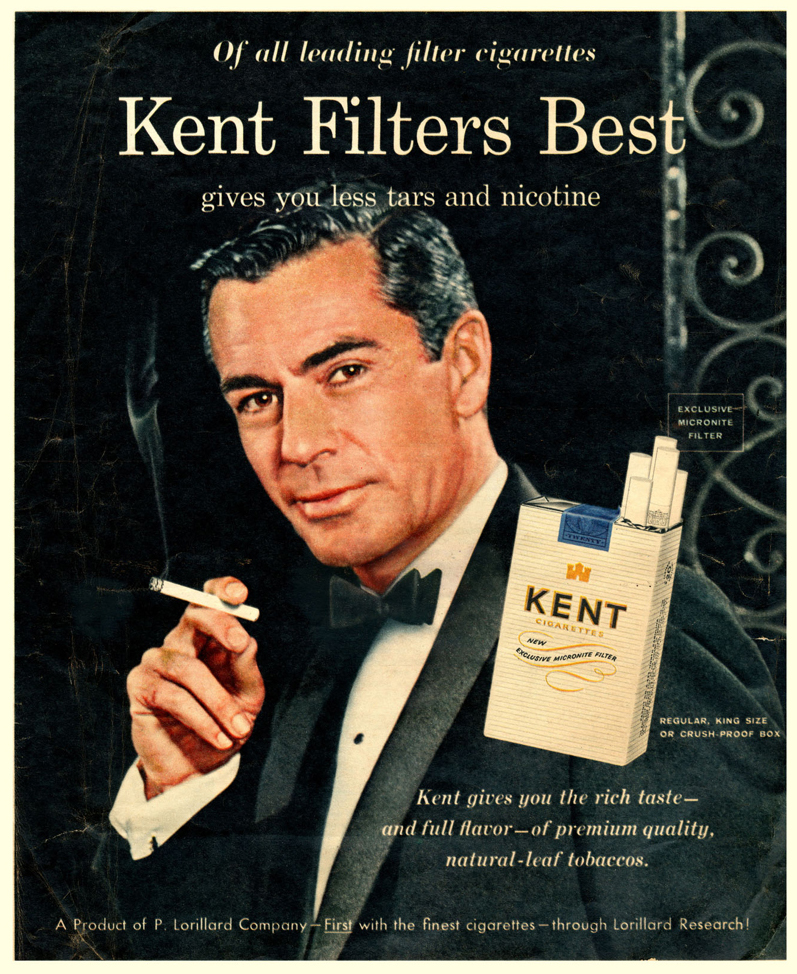
Kent’s 1952–57 Micronite filter was 15–25% blue asbestos — the deadliest kind. Ads called it “so safe… selected to help filter the air in hospital operating rooms” and ran in medical journals. This one boasts that scientists preferred it.
Smokers inhaled asbestos fibers; so did the women who made the filters. Mesothelioma cases followed for decades.

Internal research showed smokers compensate — inhaling deeper, covering vent holes — so light cigarettes delivered the same tar. The industry marketed them anyway because health-anxious smokers would otherwise quit.
The marketing worked so well that switching to lights became a standard “compromise” instead of quitting — exactly as designed.

“Reach for a Lucky instead of a sweet” — American Tobacco pitched cigarettes as weight control, specifically to women, from the 1920s onward. Edward Bernays’s 1929 “Torches of Freedom” stunt had debutantes smoke in the Easter Parade as a staged feminist gesture.

Internal research tracked “the Black market” as its own segment. Execution: Kool jazz festivals, street teams handing out free menthol packs, Ebony/Jet saturation, billboards concentrated in Black neighborhoods. RJR went further in 1989 with Uptown — a brand built explicitly for Black smokers, killed only by community protest.

RJR’s 1990 Dakota plan targeted 18–24 women with no education past high school, service/factory jobs, “no career prospects,” who watch Roseanne and listen to classic rock. The internal segment name: “virile females.” The plan leaked to the Washington Post; outrage killed Dakota in test market.

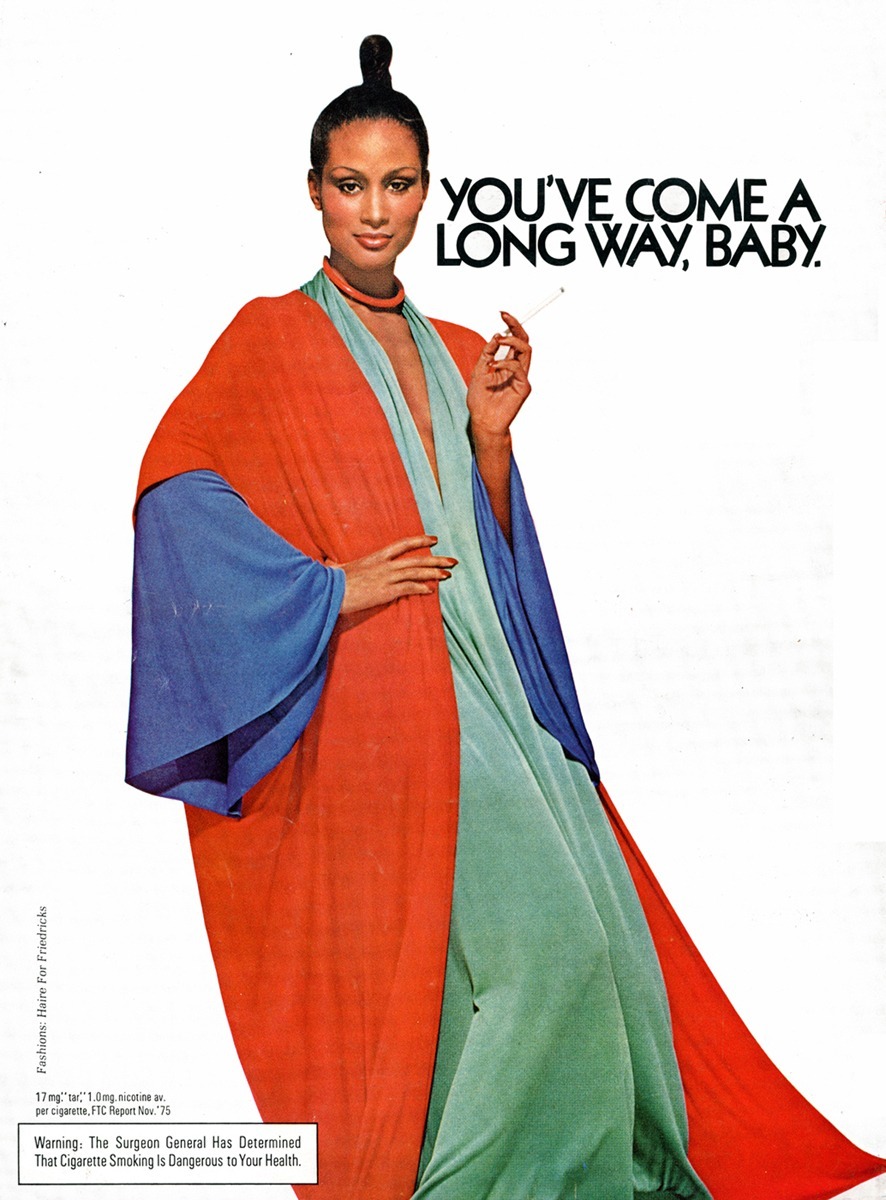
Virginia Slims (1968+) sold cigarettes as feminist liberation — slim packs, “you’ve come a long way, baby” — while internal segmentation treated women as an under-tapped growth market. Same era: diet-aid pitches (#16) ran in parallel.

RJR’s 1995 plan to push Camels in San Francisco “alternative lifestyle” areas — gay people in the Castro, homeless in the Tenderloin, “street people,” through head shops. Rationale on the page: “higher incidents of smoking in subcultures,” with “and drugs” handwritten in the margin.
A later copy has “SCUM” crossed out on the cover and “Sourdough” written in — they realized the name showed what they thought of their customers.
Documents show the industry tracked its “downscale” market, cultivated homeless shelters and advocacy groups for goodwill and political cover, promoted the idea that schizophrenic patients needed cigarettes as self-medication — and worked to block smoking bans on psychiatric wards.
Smoking rates among people with schizophrenia ran as high as 80%.
There wasn’t one.
This was never meant to be seen.
WWII K-rations included a 4-pack per meal — 12 cigarettes a day issued to every soldier. Companies shipped cigarettes overseas by the millions and ran patriotic ads (“First in the Service”). A captive generation of stressed young men came home lifelong customers.

Nurse recruitment (“America needs nurses… enlist now”), a Paramount movie tie-in, and a cigarette pack — all in one 1943 Chesterfield ad. Patriotism, healthcare, and Hollywood fused into a single pitch.

“Doubt is our product since it is the best means of competing with the ‘body of fact’ [linking smoking with disease] that exists in the mind of the general public. It is also the means of establishing a controversy.” — Brown & Williamson, 1969 (Bates 690010960)
The strategy fossil fuels, opioids, and every contested industry still runs. It started here, in writing.

After cancer evidence went public, the industry hired Hill & Knowlton and ran a full-page ad in 400+ newspapers promising to fund “independent” research — creating the Tobacco Industry Research Committee, a PR operation designed to keep the science “controversial,” not resolve it.

From 1987, Philip Morris paid scientists to dispute secondhand-smoke findings — recruited through the law firm Covington & Burling so payments stayed privileged. The screening criteria: scientists with “no previous record… which might lead to problems of attribution.” Tobacco wasn’t even mentioned in initial outreach. 81 scientists across Europe and Asia by 1988.

“It’s the Law” / “We Card” campaigns existed to preempt regulation and give execs something to point at in hearings — internal analysis treated them as political cover, not public health.
Juul later ran the identical play: paid schools ≥$10,000 each for classroom access, presented to students with no teachers in the room, called the product “totally safe” — and internally circulated the paper that had killed Philip Morris’s equivalent program.

Baseball players, Olympians (Camel ran Olympic skater Kit Klein in 1936), and later the broadcast-ban workaround: when TV ads were outlawed in 1971, the money moved to F1, NASCAR, and event sponsorship so the logos stayed on screen.

US Smokeless planned a literal pipeline: start new (young) users on sweet/mint low-nicotine starter products — Skoal Bandits Mint, cherry Good Luck — then “graduate” them up the nicotine ladder to Copenhagen. Internal memo, on pouch tobacco: aimed at “consumers not yet using tobacco products” because it was “with it” to snuff among young people.
There wasn’t one.
This was never meant to be seen.
From Juul’s own files (House Oversight, 2019): paid schools for direct student access, hired “280 influencers” to seed product in LA/NY, recruited “buzzmakers” with ≥30K followers, targeted kids as young as eight in camps and out-of-school programs — while internally acknowledging the programs were “eerily similar” to Big Tobacco’s.
Fifty years between “today’s teenager is tomorrow’s potential regular customer” and a Saturday-school Juul demo. Same machine.